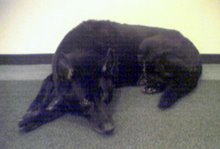
Today is a sad day for me. I'm posting Ivor's animal in the absence of Ivor, Jonathan, AND Amy. I feel like I'm alone in the world.
In honor of Ivor's move to Seattle, Ivor is a nimble mountain goat. Native to the Northwest, Ivor is able to navigate rocky terrain and climb slopes as steep as 60 degrees - that is, he would if he didn't have arthritis now. This helps him keep above the timberline on mountains, thus avoiding predators. He has dense, thick fur that he molts every Spring and Summer - which is why we've been having so much fun pulling clumps of shedded hair off of him. Most of his life consists of eating and lying down.
Ivor also shares his name today with one of Sam's favorite bands, The Mountain Goats.
Monday, July 2, 2007

Friday, June 29, 2007
Ivor is Himself
posted for Amy:
Today Ivor is himself, a german shepherd. He is known for his keen intelligence; self-confidence; trainability; poise; affable, easy-going nature; and strong protective instinct. He is both lively and alert. His body is long and well-muscled, and he bears a look of true nobility.
He moves without effort, smooth and rhythmic, covering the maximum amount of ground with a minimum of steps. Ivor’s eyes indicate the love and affection he has for those who care for him and his sweeping tail shows his mood whether happy or sad. He is a friend for life! He is quick to learn and thrives on work. He loves human companionship and will respond to his owner’s mood. At all times, his one desire is to be with you and to please you. He can live anywhere as he is happy wherever you are happy.He has a keen sense of humor and enjoys playful games yet.
Ivor will be moving soon with Jonathan and Carla to Seattle. We will miss him, but he has promised to visit us. He has been the centerpiece of our office.
“You ask of my companions. Hills, sir, and the sundown, and a dog as large as myself that my father bought me. They are better than human beings, because they know but do not tell.” Emily Dickinson
Today Ivor is himself, a german shepherd. He is known for his keen intelligence; self-confidence; trainability; poise; affable, easy-going nature; and strong protective instinct. He is both lively and alert. His body is long and well-muscled, and he bears a look of true nobility.
He moves without effort, smooth and rhythmic, covering the maximum amount of ground with a minimum of steps. Ivor’s eyes indicate the love and affection he has for those who care for him and his sweeping tail shows his mood whether happy or sad. He is a friend for life! He is quick to learn and thrives on work. He loves human companionship and will respond to his owner’s mood. At all times, his one desire is to be with you and to please you. He can live anywhere as he is happy wherever you are happy.He has a keen sense of humor and enjoys playful games yet.
Ivor will be moving soon with Jonathan and Carla to Seattle. We will miss him, but he has promised to visit us. He has been the centerpiece of our office.
“You ask of my companions. Hills, sir, and the sundown, and a dog as large as myself that my father bought me. They are better than human beings, because they know but do not tell.” Emily Dickinson
Thursday, June 28, 2007
Flying Fox
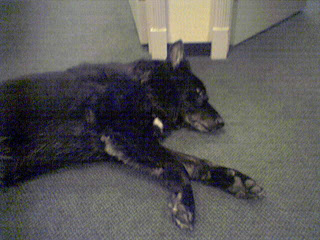
Ivor is a flying fox today.
So called because of their large size and canine features (like German shepherds, flying foxes have doglike muzzles and pointy ears), flying foxes feed on pollen and fruits. Unlike smaller bats, Ivor sees quite well (a good thing, since he is a guide animal) and doesn't have the ability to echolocate. The largest of all bats, Ivor has a wingspan of over four feet, even though he weighs only about 3 pounds! While he eats mainly at night, he's still active during the day and eager to interact with others. He's part of larger a family of fruit-eating bats known as fruit bats, and is less feared than other bats because he eats fruit instead of hunting for prey, and because his features so closely resemble those of dogs. This may be why he's called a "flying fox" instead of a "bat."
Today we're giving Ivor lots of water because he loses so much moisture through his wings. Even though he is supposed to eat at night, he's getting a few treats during the daytime too, in between his naps.
So called because of their large size and canine features (like German shepherds, flying foxes have doglike muzzles and pointy ears), flying foxes feed on pollen and fruits. Unlike smaller bats, Ivor sees quite well (a good thing, since he is a guide animal) and doesn't have the ability to echolocate. The largest of all bats, Ivor has a wingspan of over four feet, even though he weighs only about 3 pounds! While he eats mainly at night, he's still active during the day and eager to interact with others. He's part of larger a family of fruit-eating bats known as fruit bats, and is less feared than other bats because he eats fruit instead of hunting for prey, and because his features so closely resemble those of dogs. This may be why he's called a "flying fox" instead of a "bat."
Today we're giving Ivor lots of water because he loses so much moisture through his wings. Even though he is supposed to eat at night, he's getting a few treats during the daytime too, in between his naps.

Wednesday, June 27, 2007
Platypus:
Today Ivor stayed home because it is too hot outside and there weren't enough creeks in the office for him to dive into in search of food. Amy sent this email to us telling us what animal Ivor is:
Ivor is a platypus today. His broad, flat, coarse, bristly tail acts as a powerful rudder when he swims and dives for food. He uses his webbed fore-paw to steer in the water, and to walk or burrow while on land.
Unfortunately, for Karla, the spur on the inner side of each hind limb holds poison. But no need to worry. As a platypus, Ivor will spend about 13 hours today foraging for food, using his electro-sensitive bill to locate and probe for worms, insects, crustaceans, molluscs and small vertebrates such as tadpoles. He’ll dive for between 20-40 seconds during foraging, resting on the surface for only 10 seconds between dives. He’ll perform about 80 dives per hour. A great Olympiad! Once he catches it, he will carry his prey in his cheek-pouches and use his small, horny pads to crush them.
Big surprise, Ivor can consume up to half his own body weight a day. Glad Karla doesn’t have to feed him, but seems like she may have to clean up a bit if with all that crushing. As for the poison risk, Jonathan will have to deal with that when he comes home.
Tuesday, June 26, 2007
Arabian Horse
Amy is posting by proxy today:
Today, Ivor is a Black Arabian horse, quite fitting since Arabians have a reputation for intelligence, high spirit, alertness, and outstanding stamina. Ivor comes from a distinguished line, as Arabians are one of the oldest horse breeds, perhaps dating back 4,500 years, and are one of the top 10 most popular breeds in the world. Surely the most popular at the ABA! The Arabian also has a close relationship with humans and is good-natured, quick to learn, and willing to please. Right on the mark! This combination of willingness and sensitivity requires owners like Jonathan to handle his Arabian with competence and respect.
“The black Arabians seems to have something magical, something that makes people go all starry-eyed and dreamy.” “For us – the Arabian lovers – it's clear that the Black Beauty must have been Arabian as only Arabian horses are so tender, intelligent and brave, combining these features with grace and majesty.”
Today, Ivor is a Black Arabian horse, quite fitting since Arabians have a reputation for intelligence, high spirit, alertness, and outstanding stamina. Ivor comes from a distinguished line, as Arabians are one of the oldest horse breeds, perhaps dating back 4,500 years, and are one of the top 10 most popular breeds in the world. Surely the most popular at the ABA! The Arabian also has a close relationship with humans and is good-natured, quick to learn, and willing to please. Right on the mark! This combination of willingness and sensitivity requires owners like Jonathan to handle his Arabian with competence and respect.
“The black Arabians seems to have something magical, something that makes people go all starry-eyed and dreamy.” “For us – the Arabian lovers – it's clear that the Black Beauty must have been Arabian as only Arabian horses are so tender, intelligent and brave, combining these features with grace and majesty.”
Monday, June 25, 2007
Opossum
Today Ivor is a Virginia Opossum. You can tell because today he's lying in the middle of the hallway, risking being run over by people walking back and forth! Instead of getting out of the way of foot traffic, Ivor, like many opossums, "plays dead" by lying down, hoping that the source danger will leave him alone. Sadly, this strategy does not work too well, and Ivor risks being kicked accidentally today.
The Virginia Opossum is the only marsupial in North America. They are adaptable and live in all sorts of habitats, including urban areas, and are remarkably resistant to rabies. That's a good thing, since Ivor lives in the city and we don't want him getting sick (he's been vaccinated, of course, but natural resistance always helps). Although they look like rats, they're more closely related to other marsupials - including kangaroos and wombats - than to rodents. Sadly, opossums aren't very long-lived, so overall it's a good thing that he is turning into something else tomorrow.
The Virginia Opossum is the only marsupial in North America. They are adaptable and live in all sorts of habitats, including urban areas, and are remarkably resistant to rabies. That's a good thing, since Ivor lives in the city and we don't want him getting sick (he's been vaccinated, of course, but natural resistance always helps). Although they look like rats, they're more closely related to other marsupials - including kangaroos and wombats - than to rodents. Sadly, opossums aren't very long-lived, so overall it's a good thing that he is turning into something else tomorrow.
Friday, June 22, 2007
Lyrebird
Ivor is a superb lyrebird today. He lives in Australia and looks unassuming - like a brown pheasant - except for his elaborate tail. As an adult male, Ivor has curled feathers (roughly S-shaped, like the holes on a violin). Some scientists studying lyrebirds who had not seen a live lyrebird before used to believe that the tail, when displayed, would look like a lyre. However, that is not true.
Ivor's most appealing feature today is his talent for vocal mimicry. The great majority of lyrebird songs - about 80% - are actually impressions of other sounds they have heard. This may include the songs of other birds, but also more "modern" sounds like the click of a camera or the buzz of a chainsaw. You can hear one of Ivor's cousins demonstrating his repertoire in this video on YouTube.
What will Ivor mimic today? The clacking of keyboards? The chatter of a screen reader? Maybe even the voices of his friends? It's really anyone's guess. Today may be confusing. We may be fooled into thinking that a car alarm is going off right in the hallway, that Karla is down the hall saying "hi" to someone, or that John is typing in his office when in fact he's out to lunch.
Ivor's most appealing feature today is his talent for vocal mimicry. The great majority of lyrebird songs - about 80% - are actually impressions of other sounds they have heard. This may include the songs of other birds, but also more "modern" sounds like the click of a camera or the buzz of a chainsaw. You can hear one of Ivor's cousins demonstrating his repertoire in this video on YouTube.
What will Ivor mimic today? The clacking of keyboards? The chatter of a screen reader? Maybe even the voices of his friends? It's really anyone's guess. Today may be confusing. We may be fooled into thinking that a car alarm is going off right in the hallway, that Karla is down the hall saying "hi" to someone, or that John is typing in his office when in fact he's out to lunch.
Subscribe to:
Posts (Atom)